I wrote this piece in 2010, but I am republishing it because my Dad, Peter Baldwin, is very ill, and I’m also preparing an exhibition that includes his work. It comes from an interview with Peter about his art and his relationship with the coast.
My story begins in Aldeburgh, a very special place for my family, a town on the long stretch of Suffolk coast, built on little else but constantly shifting shingle. This is where my Dad grew up and where we camped for many summers to get a dose of the place he felt was home. My Dad, Peter Baldwin, spent much of his youth hanging out with his grandfather, the local coastguard. In all the weeks we stayed in Aldeburgh, and despite my love of swimming, I’m sure I never swam in that sea, as the current pulls so strongly southwards parallel to the shore. I think too I was a little put off by my father’s stories of distressed and drowning boatmen, of bloated bodies and the treachery of this sea.
This was one of those stories…
In the last days of January 1953, my great-grandfather Herbert Abbs spent hours with his binoculars raised in his lookout tower. The lookout had to be a high tower because the land here is so low relative to the sea. The land has always been low, but the town now sits at the lowest level in its history because the whole of Eastern England is subsiding gradually, tipping towards the sea. The tower also has to be high because this is treacherous coastline: Beneath the water are constantly shifting shingle banks, which can ground or topple a boat pushed off its course. The coastguards, pilots and lifeboats here work hard.
All week, Herbert studied the fractious weather and sea. He had been trained to do this well since early childhood, as the diligent son of a distinguished Naval officer and coastguard, and then as a Naval officer himself. As it ever was, the North Sea was gunmetal grey. But he felt something was odd about the heavy prison-blanket of a sky, about the wind and the waves. He made his calculations and knew that this was going to be a surge as high as the one in 1947, if not worse. Before a surge, the sea is lifted up towards the sky as if it is taking an enormous breath. He knew that this lift, followed by a massive surge onto the land, was going to happen. He did his duty by telling his superiors what he knew was coming, posting regular observations first by telephone, later by radio, and ensuring that the town was readied for the Great Flood.
He didn’t know that his warnings had not travelled as forcefully as the tide and as far as he had hoped. It was a weekend, and so all the decision-makers and civil servants were taking a break. The gale-force winds had blown down the telephone lines. No official body was coordinating national emergency communications to warn everyone around the coast.
On the night of 1st February, the high waters burst over the sea wall and up from the river estuary South of the town. Aldeburgh suffered no loss of human life that weekend, which may be partly due to Herbert’s warnings. It is certainly because Aldeburgh had so few temporary homes. Further up the coast, in Lowestoft for example, most of the victims lived in prefabs and caravans.
He helped co-ordinate the evacuation and rescue of people from their homes, the formation of an amateur radio network to communicate with the outside world and, in the days that followed, work to clear up all the damage and to rebuild the broken banks. As a hangover from the 2nd World War, there were still plenty of soldiers around, so they provided vital help.
When I was a child, he would sit in his Captain’s chair sipping his dark-brewed tea, with the wrestling turned up loud on the TV, while I sorted through his tin of buttons or did a jigsaw puzzle. The story I recall him telling most often was an older memory, as his more recent memories were dying. This was about how he led the capture of a German U-boat during the Battle of Jutland in the First World War. A clever and commanding sailor, he and his superiors had been in control of the situation, and so he was in control of his story, though it had clearly been a terrifying experience. The British Navy evaded the German dreadnoughts because of their intelligence and their use of telecommunications in intercepting German radio signals. Also, the entire Grand Fleet communicated well with each other, following strict procedures. I think he found it a great deal harder to make sense of what had happened during the 1953 floods. The breakdown in communications and order in 1953 must have been distressing to him.
Just south of Aldeburgh is Orford Ness, the longest shingle spit in Europe. In this isolated spot, Herbert had served as coastguard in the 1930’s. Here, some of the most advanced telecommunications innovations were being developed. The British were leading the world in radar and telephony thanks to the experiments being conducted there. Herbert’s own son-in-law, my Grandfather, Ronald Baldwin, was involved in laying the first telephone cable from the Ness under the sea across to Holland.
So, how could communications have failed so badly in 1953? Why did the authorities not act on his warnings?
Major floods had happened a few times in the past century, but they had not caused such massive loss of human life, livestock or land in England for many years. It might be argued that so much effort had gone into defending the coasts against military attack and honing military communications that there was little attention given to the risk of flood. Moreover, in the late 1940s and early 1950s, the country was recovering from war, building homes and industrial infrastructure, not planning against the risk of freak events of nature. Where were many of these new homes being built? In coastal and estuary areas, of course. The most significant reason for the extent of the casualties and damage in 1953 was this coastal development. The rate of coastal development has continued since the 1950s despite the dilapidation of many seaside towns because the land is often flat, cheap and plentiful.
I wondered how Aldeburgh had changed in the past decade, and I wanted to discover how people felt about the threat of rising sea levels. My Dad lives in North Norfolk now, but I persuaded him to meet me in Aldeburgh so I could talk about these things. It is from him that I’ve inherited my nostalgic feeling for the sea. His own identity as an artist is wrapped up with hard-to-answer questions about belonging to coastal places. On the whole, he asks these questions by being a painter and by thinking and teaching about painting. Conversely, he has also been very involved in politics, and as a county councillor he was deeply involved in coastal management. In particular, he devoted many years to the plight of Norfolk people whose homes are falling into the sea.
I’ve often heard him talk about his family and the Suffolk coast, but I’d never really tried to draw him out, to unravel the skeins of myth and fact. I knew that Benjamin Britten’s presence in Aldeburgh was important to him although I wasn’t sure why. A week before meeting him, I went to see Benjamin Britten’s opera Peter Grimes performed at the English National Opera (ENO). This is based on George Crabbe’s 1810 poem The Borough. As Crabbe was a native of Aldeburgh, we can assume the poem is set there. To be precise, it was probably set in the fishing hamlet of Slaughden, which used to stretch south of the town but is now entirely under the sea.
Peter Grimes is a fisherman ostracised by the villagers because of his negligent involvement in the death of his young apprentices, one after the other. He takes risks and forces his apprentices to do the same, to be men, to fight the sea so that they could be successful fishermen. Though Grimes is a powerfully tragic character, the most dramatic actor in this opera is the sea. It causes a flood that breaks the sea wall. It causes the townspeople to huddle together and to firm up their community along with their sea defences. It causes the deaths that lead to Grimes’ shaming and suicidal drowning. Britten’s music is the voice of the sea and wind, mingled with the voices of the Borough people. These sea interludes hover between sonorous peace and fretfulness.
The ENO staging was set in the 1940s, the era in which Britten was settling in Aldeburgh, and so it feels closer to our own time. The costumes and the sepia-to-grey, sea-washed tones were evocative of memories of my family’s life there, imagined from stories and seen in photographs. I could see from the sets what I knew of Aldeburgh, the fishermen’s huts, the church hall, the pub, the esplanade and looming over it all, at a higher line than the land, the horizontal line of the sea.
Of all the words, I was most struck by this exchange:
Peter: I am native, rooted here.
Balstrode: Rooted by what?
Peter: By familiar fields,
Marsh and sand,
Ordinary streets,
Prevailing wind.
Peter Grimes feels part of the ecosystem of the shingle, marsh and sea, a person who goes out to sea for days, potentially free in his fishing boat, yet who is also rooted to the land he must return to. However, a storm pushes him off course, and he drifts for days in a state that is as good as death, sharing a boat as he is with rotting fish and a dying-to-dead apprentice. At the conclusion, his only course is to commit suicide by getting into his boat and going away.
The story implies you must all find a place to be home, authentically and ethically rooted. It also starkly says that, for humans, to be at sea is the same as death.
In 1941, Britten was in California with his partner, the singer Peter Pears. They were there in self-exile from the War as conscientious objectors. Together they read Crabbe’s poem. Britten was a native of the Suffolk coast, from Lowestoft, though he had stayed in Aldeburgh. He realised immediately that he must write an opera from this poem, and he also knew that Aldeburgh was where he belonged. He returned to England in 1942, wrote Peter Grimes in 1943–5 and settled finally in Aldeburgh in 1947.
In 1946, when my dad Peter was five years old, his father, Ron Baldwin, returned from his service in the Army. Ron had been stationed in Italy as a radio engineer, where he had come to appreciate Italian opera. However, he wasn’t so enamoured of Britten’s modern music. Like everyone in the town, my dad’s family was immediately very aware of Britten. He was the focus of much talk about the value of art and artists, about his being leisured and ‘different ’, including his being gay, but especially of talk about whether he contributed anything real to the community. Ron believed that artists contributed nothing. Or rather, Ron had no respect for artists who didn’t entertain ordinary people or provide the town with commodities.
I met up with my dad at the Mill Inn, which Ron’s parents ran in the 1930s and 40s. Dad tells the barmaid that he remembers crawling on the floor here as a baby. She looks at him blankly and carries on pouring the beers. She can’t know the meaning he attaches to this place. After all, she still lives here in these ordinary streets. The Mill Inn is a tiny old pub on the seafront. It overlooks the medieval Moot Hall, which stands isolated close to the beach. This Borough still has its own Mayor despite the tiny scale of the town, and the Moot Hall is the ancient meeting place of its councillors. Dad points out to sea and says ‘This Hall was once at the centre of the town, and more than half of it is now all out there’. He points out how low the ground is here, relative to the sea level. The sea almost commands us, calm as it is today.
The next morning we walk north along the sea path. Ahead of us in the distance, the Sizewell B nuclear power station is small as a ping-pong ball, shimmering insubstantially in the haze. We are aiming for the Scallop sculpture by Maggi Hambling, commissioned to commemorate Britten. It is sited to the north away from the houses because Britten used to walk daily up this way, composing in his head and gazing out to sea. I asked my dad if he used to see Britten here.
“Of course. I used to follow Britten up here with my sketchbook. He composed on his piano in the morning and went for a walk in the afternoon. You could see something was happening in his mind. There’s the aspect of creative practice that is studio-based, and there’s a more freeform rambling, and for him the creativity came with his rambling while walking, allowing ideas to emerge. I used to watch him and wonder what was going through his head. He was doing lots of standing and staring. I’d never seen people doing that before. They either worked or relaxed, but never stood and stared. I used to watch his scalp move, as he was concentrating, trying to get emotions into a musical form. I would draw him like that.”
So it turns out my Dad was a kind of shadow artist, a wishful apprentice. I realise that The Scallop is not just a memorial for Britten but for all the people he inspired to stand on that shore and try to make form from the insomniac sea and our lives alongside it. The words of Peter Grimes, ‘I hear those voices that will not be drowned’, are cut into the edge of the shell. It shines, for the time being, in the dazzling sun.
My Dad is bothered that the sculpture was sited so far from the town. He keeps mentioning it. I think he feels it implies that Britten wasn’t part of the community. He has always been sensitive to any antipathy towards art and artists, expressed this time by those people who criticised the Scallop and the town’s investment in it.
It is certainly unusual to place a sculpture on such a featureless beach, where there are no other structures, with only the flat meadows behind the shingle bank and the sea before. It functions as a windbreak and a shelter, a stopping place on your journey where you can gaze at the sea. From there you can choose to go on or return home. The scallop is a badge of pilgrimage, so this sculpture gives form to the idea of a resonant journey, a setting out to find a kind of spiritual home.
I asked Dad if he feels he is native to Aldeburgh, rooted here like Grimes. His mother’s family had moved from Sheringham on the North Norfolk coast when Herbert was stationed as a coastguard, first on Orford Ness, then later in Aldeburgh. His father Ron’s parents had moved to Aldeburgh from Buckinghamshire to run the Mill Inn. So, neither family belonged here but it is the place he would call home, the home he wishes he hadn’t left. He now lives in Sheringham, which is, in fact, more than any other place, the home of his ancestors. But he tells me he has just bought a caravan near Dunwich so that he can come and stay and is thinking about buying a house here. I want to know why he has such an attachment when he was not so very happy with his father here.
“For me, Aldeburgh was a community based on care and I often felt that I was cared for more by the community than my family, with the exception of my grandparents. I escaped all the time from home into this generous community around me. I was out on my bike on the promenade — I’d spent a lot of time playing on the beach and when I came back the bike had disappeared. I went home to tell them what had happened, to discover that my bike was already at home. An elderly chap had seen my bike was there and had been for some time and thought it should be home for safekeeping. That says an awful lot about the place and the people.”
I asked him, didn’t you find this community sense about the places you lived subsequently? I have an idea his answer will be mixed because I know he liked the small city where I was born, Norwich, as there was a cultural scene, but my mum wanted to move to the country. However, I think he agreed to relocate because he wanted to move on to find another place that could be more of a home.
His answer confirms what I thought: “There’s a psychologist who’s done a lot of research into size of community and mental health. Very rural and very urban places have higher suicide rates. People need to know each other. I always felt like a fish out of water afterwards. I felt homesick. It wasn’t just the places, the environment, but that I was never again in a community that cared so much. That’s why I’ve always been involved in politics and voluntary work because it reflects this sense of values that I first experienced. Aldeburgh was a conservative town, dominated by institutions like the church, the scouts and the fishermen. It’s hard to pinpoint, but there were several bonding institutions that reaffirmed this sense of community.”
So, he expresses a strong wish to belong and appreciation of groups that forge belonging and yet, perhaps entirely consistently, he has also had a tendency to feel like an outsider. I want to know more about that, where that feeling of ‘rooted outsider’ comes from.
I ask him: So, you identified with Peter Grimes, why was that?
He says that he did, but it seems mainly because of the link with Britten. “I mostly identified with Britten. When he went to America, he went there to feel free because he was gay and a pacifist, but he felt that he needed to come home. It was the discovery of the poem by Crabbe, and his identification with Peter Grimes that made him know where he belonged and want to come back.”
He explains that Grimes feels apart while also being ‘native here’, that he’s a good fisherman, a member of the community and a part of the landscape. “I think artists feel like that, that they can talk to everyone and feel at home in a sense but have a vocation that sets them apart. I think they’ve always been inclined to work from a studio being alone, but at the same time coming out and needing common ground and other sympathetic people.
So, what I’ve done in my life is promote community in the political sense as well as in the artistic sense as I’ve always wanted things to be organised so that arts can be provided for people. I think the primary purpose of art is for people…it fosters your emotional intelligence so it’s capable of bringing people together and reinforces the relationship between people and the natural world.”
I wonder if my dad’s feeling that he is ‘native here’ is an attempt to forge a more fixed and possibly acceptable identity, given that his family comes from other places. I ask him: What makes you feel rooted here? His answer is interesting because he isn’t as fixated with this one place as I’d thought: “It’s the interface between land and sea, that makes me rooted to places like this, not just to Aldeburgh.”
He then attempts to explain this connection between artists and the sea:
“I was listening to a radio programme, Ramblings, about Aldeburgh. The music critic of the Sunday Times was doing a doctorate about the relationship between Britten’s music and Jung, so he arranged to visit in the late 60’s when Britten was ill. This researcher was very young and in awe and spent the whole day there, but they never got round to talking about the thesis. Britten just wanted to know what people thought about his music. He wasn’t going to be drawn on his inner motives. He didn’t want things to be revealed.”
I don’t know if my Dad is unwilling to be drawn on his own inner motives or not. I think he creates and releases to the world a contained symbolism, a set of readings of himself and his work. He appreciates symbolism but not a deeply extractive psychoanalysis. I think that may be fairly common to the generation of British artists who were touched by the trauma of war but who embraced the romantic dimension of Modernism.
“Jungians see the sea as meaning the infinite, going on journeys, but it also has to do with death. If you look at the Romanticists, like Bocklin and Friedrich, the sea represents death. That relates to Peter Grimes. The story was written by George Crabbe in that Romantic era. For me, Peter Grimes is the artist. There’s the interface between land and sea, the whole notion of attempting to make something significant, to make markers that define your existence and then beyond that, there is the journey into the unknown.”
“The poet Auden was at the Gresham’s School in Holt with Britten. Auden was older and encouraged him, and the school itself really did bring out both their talents. There’s a monument outside the Auden Theatre at Greshams. It’s to do with the creative person, the artist. It says that when they make a work of art, they are breaking bread with the dead. That means you’re making something that is derived from a communication with the people that have gone before, acknowledging a creative inheritance from past artists. Once you’ve died, your work is breaking bread with the living.”
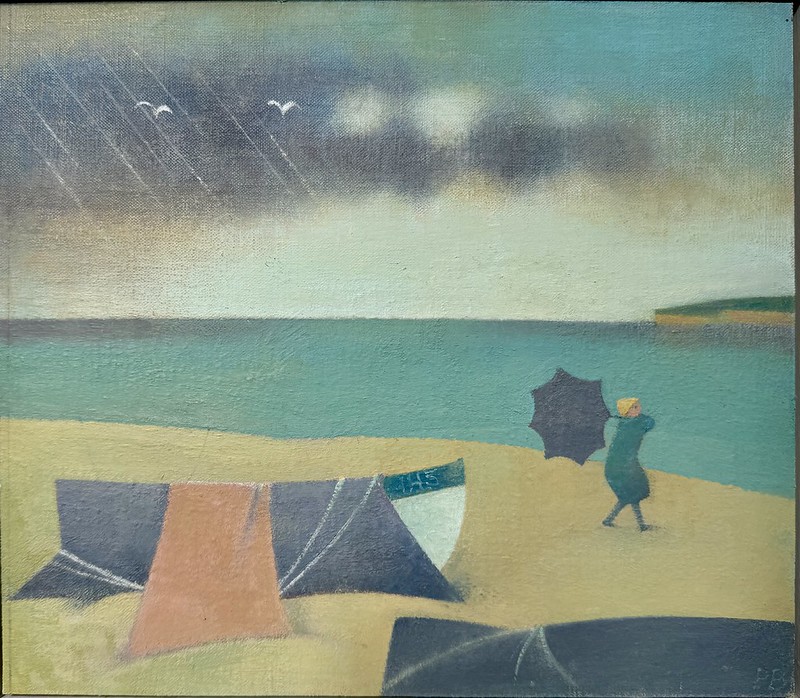
I knew that the sea was very important in Dad’s painting, and asked him to tell me more about the particular meanings of symbols for him. He started by talking about the symbolism of the lighthouse and the coastguard lookout.
“The lighthouse and the lookout has meaning for me as a father or guardian. I had a grandfather who looked out for me, and a father who by contrast, wanted to be controlling without caring.” He especially associates places by the sea, as places of looking out and caring. “Because living by the sea is threatening, there has to be a respect for the sea and a watchfulness.”
He tells the story of the rescue of the Kentbrook, which features in his work (although I hadn’t heard him talk of it before). The SS Kentbrook was a coastal steamship that came aground off Orfordness in 1954. “It was breaking up in the waves, and my grandfather (Herbert Abbs) was responsible for their rescue. They fired a rocket to the ship and then pulled people off by means of a breeches buoy. I witnessed these men being pulled to safety through the surf, one by one. It was quite dramatic when you’re young, seeing people’s lives being saved. I just remember as each person was pulled ashore, a little cheer went up. Then Dick Smith, the medical orderly, would sort them out.”
I think; what a time it was for boys seeing men be heroes. Now we can read tweets from astronauts resident in space, about their daily functions. Back then, men at sea and at war were more mysteriously absent or, if they were present ashore, they must have been laconic.
Herbert was the coastguard for Orford Ness before the war, before moving the family a few miles up the coast to Aldeburgh. Orford Ness is a strange shingle spit used then for secretive nuclear research and military communications. I asked Dad to say more about what they thought then about the place, how it played in his imagination.
“Just what happened there I don’t know, but the fact that it was mysterious added to the glamour. People who were connected with it were seen as people of importance. When I was about 13, starting to define my ambitions as an artist…I remember sailing down the river (by Orford Ness) and seeing Havergate Island on one side, which is a bird sanctuary, where they preserved the avocet. On the other side was this mysterious territory devoted to the destruction of humans. This contrast struck me as rather interesting and I started to conceive of being an artist, wanting to say something about those ironies using visual means.”
There’s irony around this on another level. My Dad was a pacifist CND member, an Aldermaston marcher. But he has an ambivalent feeling looking back to WWII. He seems to associate his youth during wartime, before an awakening teenage consciousness, with being protected, held within a community and looking up to male role models in place of his father, who was absent in service.
“The war reaffirmed the sense of community. The threat brought everyone together. The home guard was the antithesis of the fascist idea. It came from below, people decided to do it.”
I mention Dad’s Army, but he doesn’t laugh fondly. As they were right on the edge of a flight path of bomber planes from Germany, the situation was deadly, not funny: “Just over there in Oakley Square, that fish restaurant had been the fishermen’s guild, and the army took it over to use it for bomb disposal. Once a team member came in with a fish he’d caught and said, ‘Hey, look at this’. The bomb workers looked up for a second and made a mistake, and the bomb went off. My grandmother was pushing me along in a pram when the bomb went off. There were bodies everywhere. She talked about flesh and gore hanging from the telegraph poles.”
It’s strange to think of such unimaginable horror bursting into the very particular civility and calm of Aldeburgh’s ‘ordinary streets’. And the banality of that moment: Because of a fish…an explosion. Maybe that horror is always there, in tearooms and on beaches and at level crossings, everywhere, ticking away and sometimes showing itself. Perhaps it’s the calling of an artist to reveal and defuse it.